
Fragments written during a period of personal recalibration.
Most of them were small observations rather than essays.
Some of those fragments eventually grew into a very small book.
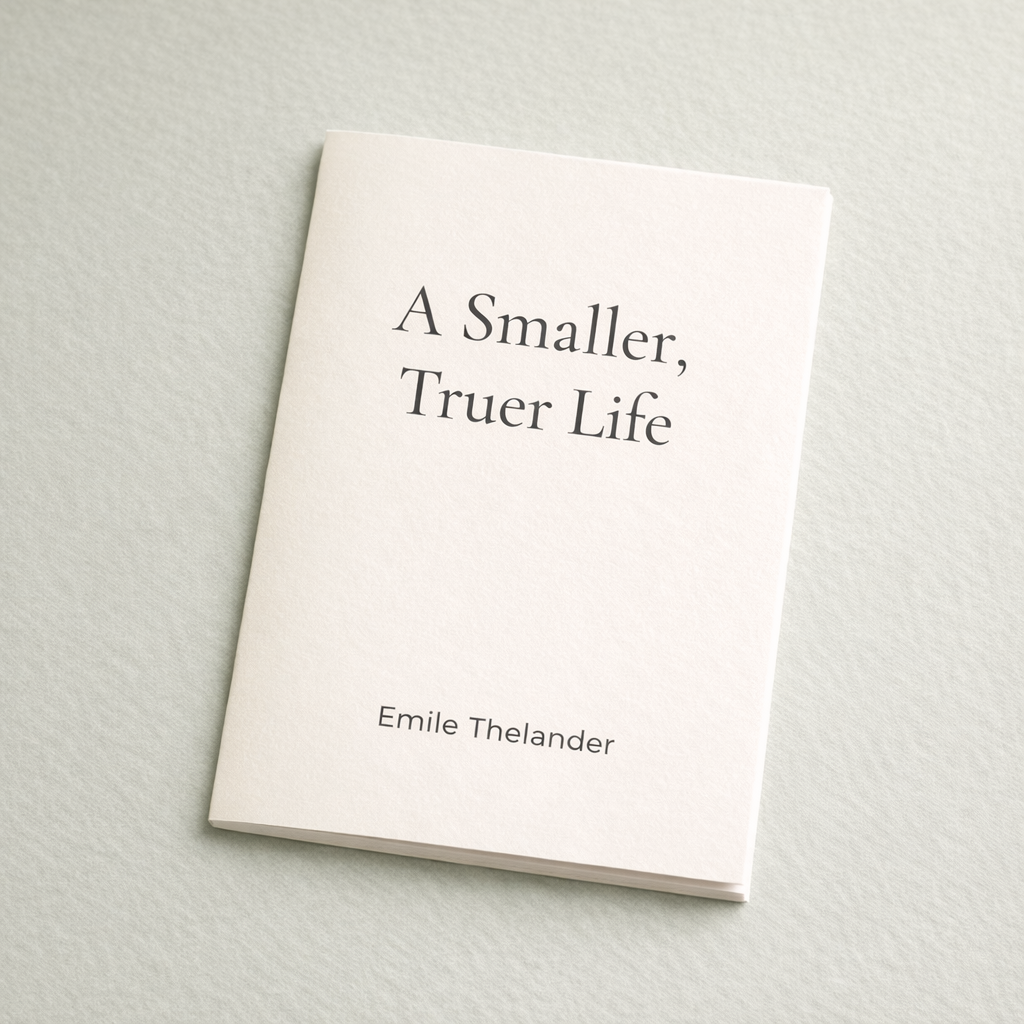
A Smaller, Truer Life
It reflects on pace, performance, momentum, and what becomes visible when you stop forcing yourself to keep up and allow your own rhythm to surface.
There are no instructions here and no productivity lessons – just a short record of what becomes visible when life slows down enough to notice.
If you’re interested in the original fragments, they are collected below:
-
Naming It
I’ve been sitting with the patterns of this year, and certain things are becoming clearer. It’s interesting how much I carry without noticing, and how quickly I step in before anyone else has even realised something might go wrong. I keep thinking of it as responsibility or reliability, but it’s more instinct than intention. My system fills gaps automatically. Maybe the next step isn’t to carry less, but to pause for a moment before I do it out of habit.
I also keep forgetting how much the environment shapes me. Noise, disorganisation, unpredictability – these things hit my nervous system harder than I admit. It isn’t fragility. It’s just reality. I’m wired to notice small disruptions, and pretending otherwise has a cost. The answer isn’t to grow a thicker skin. It’s to reduce the variables where I can.
The farm, the dogs, the slower rhythm – I keep thinking of them as the background of my life, but they’re actually the centre. Everything else orbits around that. It’s the only place where I feel a steady pulse instead of noise. There’s no need to apologise for that.
What feels true is that the next phase isn’t about big changes. It’s structural. One clearer boundary. One responsibility removed. One routine that actually steadies me. One decision finally named. Nothing dramatic – just subtraction.
-
The Body Keeps the Scorecard
The mind negotiates. The body doesn’t. Throughout the year it has been sending small signals ‒ heaviness before a storm, a tightening after too many small responsibilities, the kind of fatigue that settles in long before anything dramatic happens. None of it is catastrophic; it is simply honest.
What I used to dismiss as “one of those days” was usually the body registering strain before I allowed myself to acknowledge it. Heat, noise, interrupted sleep, the background load of holding things together ‒ the body keeps a record even when I try to override it with logic.
Lately I’ve been trying to listen earlier, while the messages are still quiet. Perhaps that is what growing older really is: catching the whispers before they have to turn into alarms.
-
The Quiet Mechanics of Living With Others
Living with people means sharing the consequences of each other’s habits, not just the space itself. Good intentions, blind spots, unfinished tasks ‒ it all becomes part of the daily weather. My instinct is to steady things before they fall, not out of superiority but because collapse irritates me more than effort.
That impulse can be useful, but it can also drain me. This year I’ve been learning to let certain things drop when they are not mine to catch. Some consequences belong to their owners, and stepping aside is not unkindness; it is simply a refusal to spend energy where it doesn’t belong.
Silence can be a boundary. Space can be a lesson. And not every imbalance needs my intervention.
-
Small Margins, Clear Choices
This year taught me that “enough” is not a vague idea but a discipline. Working fewer hours gives me space to breathe and keep my pace, yet that space is purchased with thinner margins and the need to simplify. It isn’t about abundance or scarcity; it is about the narrow line between the two.
Money shapes the texture of a day more than I like to admit. It decides how much tolerance I have to spend, how many compromises I have to make, and how tightly I need to hold the boundaries that protect my attention. I don’t need more; I just need the version of “enough” that lets me stay aligned without selling pieces of myself.
The margin may be thin, but it is mine. For now, that clarity matters more than anything larger or louder.
-
How I Stay Oriented
I don’t write to be seen; I write to stay oriented. The journals hold the noise ‒ the raw, unfiltered thoughts that gather during the day. The fragments are what remains after the heat has lifted, when the feeling has turned into something truer and more stable.
AI, for me, isn’t a shortcut but a mirror. It helps me sort the pieces, see the pattern behind the moment, and articulate what I might otherwise ignore. The tools aren’t the point; the noticing is. Some writing stays private. Some becomes signal. Both are part of staying anchored in a life that runs on interruptions.
I’m not performing anything. I am simply keeping track of myself, one reflection at a time. Attention is finite, and I’m learning to spend it where it returns clarity.
-
The Year of Recalibrating
This wasn’t a year of big constructions or reinventions. I didn’t chase milestones or try to make anything impressive. What I did instead was adjust. Small shifts, repeated. A little less obligation. A little more honesty with myself. A clearer sense of what steadies me and what drains me.
Some experiments failed quietly. Some ideas surfaced unexpectedly. Some patterns became too obvious to ignore. It wasn’t a year of achievement so much as tuning an instrument and listening for resonance. The adjustments were subtle, but they carried me forward.
Maybe recalibrating is its own form of progress ‒ slower, less dramatic, but more sustainable. At the very least, I moved through the year without losing myself in the noise, and that feels like enough.
-
December
As the year settles, I’ve been looking at what stayed, what shifted, and what finally made sense. December feels like the right place to gather those threads.
-
Not My Pace
I used to get tangled up in the mismatch between my pace and other people’s.
It hit hardest when I expected common ground. Grief feels like it should be universal. Same storms, shared weather. But we moved through it as if each had received a different set of instructions. That’s when I realised – if even this isn’t uniform, nothing else ever will be.
The shift in me has been quiet but real. I’ve stopped spending time trying to align others to my rhythm. I’ve stopped burning little calories on “Why don’t they see it the way I do?” I accept now that people run on wonky timelines, follow odd scripts, and I no longer need them to adjust themselves to match me.
It’s not resignation – it’s realism with a bit of grace.
And the relief is subtle but powerful. My system gets quieter. I can stay in my own lane. I haven’t lowered my standards. I’ve just stopped outsourcing my peace.
-
Alone in Experience
No one will ever be inside your head the way you are. Memories, sensations, moments that mattered – they vanish with you. Sharing them is only an echo, never the thing itself.
Everything that mattered to you – joy, loss, the things you lived through – dies with you. Others can witness, respond, care – but they cannot be you.
Solitude is absolute. Connection is partial. And still, we reach, even knowing the gap can never close.
-
After the Burial
After the burial, the small grievances didn’t hold up any more.
Grumpiness, pace, tone – all the things we nitpick when nothing is breaking.
Loss rearranges the furniture: what mattered an hour ago suddenly doesn’t.
I’m not trying to be better. Just quieter inside, and a little less rigid with people who move differently to me.