
Fragments written during a period of personal recalibration.
Most of them were small observations rather than essays.
Some of those fragments eventually grew into a very small book.
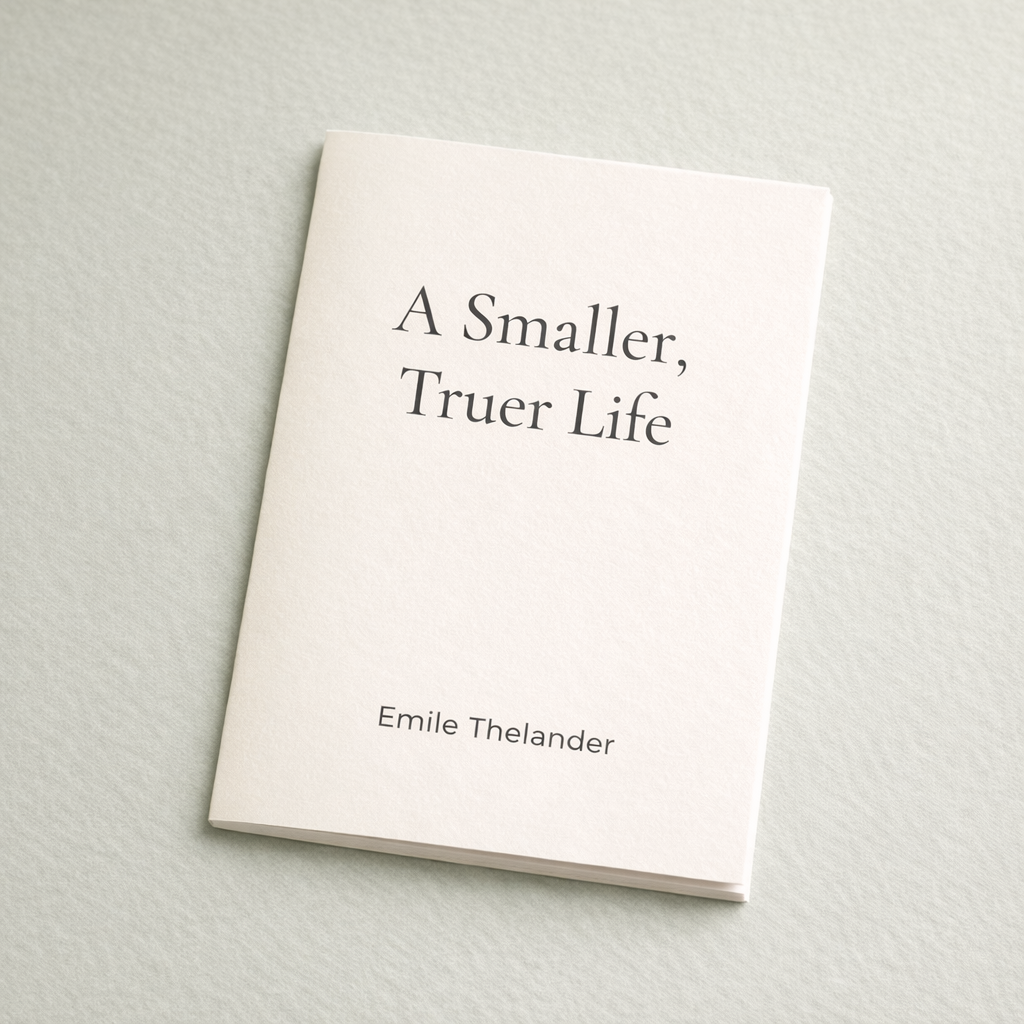
A Smaller, Truer Life
It reflects on pace, performance, momentum, and what becomes visible when you stop forcing yourself to keep up and allow your own rhythm to surface.
There are no instructions here and no productivity lessons – just a short record of what becomes visible when life slows down enough to notice.
If you’re interested in the original fragments, they are collected below:
-
After the System Leaves
When I stop being the one who holds things together, something else leaves too.
Not the chaos.
The chaos was always there.What leaves is the role I played inside it.
For a long time, being useful was how I belonged.
Seeing what would go wrong.
Stepping in.
Absorbing the impact.When I don’t do that anymore, the room feels emptier – not because I care less, but because I’m no longer filling it with myself.
There is a strange shame in being unnecessary.
A sense of being demoted from importance to presence.But maybe that’s what a real boundary costs.
Not just fewer problems –
but the loss of being the hidden system. -
Consequences
When systems are absent, consequences are the only teacher.
Advice doesn’t land.
Warnings don’t stick.
Only impact teaches what planning was meant to prevent. -
1:50
It’s 1:50 a.m.
The dogs haven’t been fed.Someone is watching a zombie show
and playing a casino game.I don’t know what to say about that anymore.
I just write it down. -
The Line
The tent arrived.
It isn’t about camping.
It’s about having a line.Between what I am willing to live inside
and what I’m not.A door I can close.
A space that doesn’t fill itself with other people’s drift. -
Unowned
Things aren’t messy here.
They’re abandoned.Clothes in the mud.
Machines half-alive.
Projects that never get closed.Nothing is kept.
Nothing is finished.
Everything is just left to decay quietly.That kind of place doesn’t just waste objects.
It wastes people. -
Where It Lands
When something isn’t owned, it doesn’t disappear. It moves. It ends up wherever there is still capacity.
By the time I’m reacting, the decision has already been made. Someone didn’t decide. Someone didn’t plan. Someone didn’t step in. The weight didn’t vanish – it just arrived in my space instead.
That’s why it never feels like a single problem. It’s heat, noise, bodies, sleep, logistics, timing, smell, tension. The small physical details are where the system shows its shape.
I’m not overwhelmed because things are hard. I’m overwhelmed because too many things are unclaimed. Other people’s non-decisions keep turning into my nervous system.
This is what “unowned problems” actually look like. Not in theory, but in where I’m supposed to lie down.
I don’t need to tolerate more. I need fewer things landing on me.
-
Unowned Problems
I confuse competence with obligation.
If I can see how to fix something, I feel responsible for fixing it.Not because I’m needed.
Not because I want credit.
Because leaving a solvable problem alone feels wrong.But many problems aren’t unfixable — they’re unowned.
And unowned problems don’t become ethical just because I noticed them. -
The Longer Attention
This year produced a number of fragments.
It also produced a small book – not a collection of fragments, but the longer attention they came from.
The fragments were moments. Distillations. What surfaced once something had already been sitting with me for a while.
The book held that while.
It’s called A Smaller, Truer Life.
It lives quietly on my Gumroad page.
-
On Avoidance
Avoidance doesn’t erase weight.
It just changes hands.When a thing is postponed long enough, it doesn’t disappear — it migrates.
Into my space.
Into my body.
Into whatever part of me still functions when someone else steps back.By the time I’m reacting, the decision already happened.
Silence already chose.
Delay already spent the cost.I’m not exhausted from crisis.
I’m exhausted from being where other people’s unmade choices land.The problem isn’t that things are heavy.
It’s that they keep being redirected. -
Quiet Permissions
The freedom to cancel instead of scrambling.
The freedom to acknowledge limits without guilt.
The freedom to stop performing professionalism when the infrastructure isn’t there.
The freedom to let the day unfold instead of wrestling it into shape.