Fragments written during a period of personal recalibration.
Most of them were small observations rather than essays.
Some of those fragments eventually grew into a very small book.
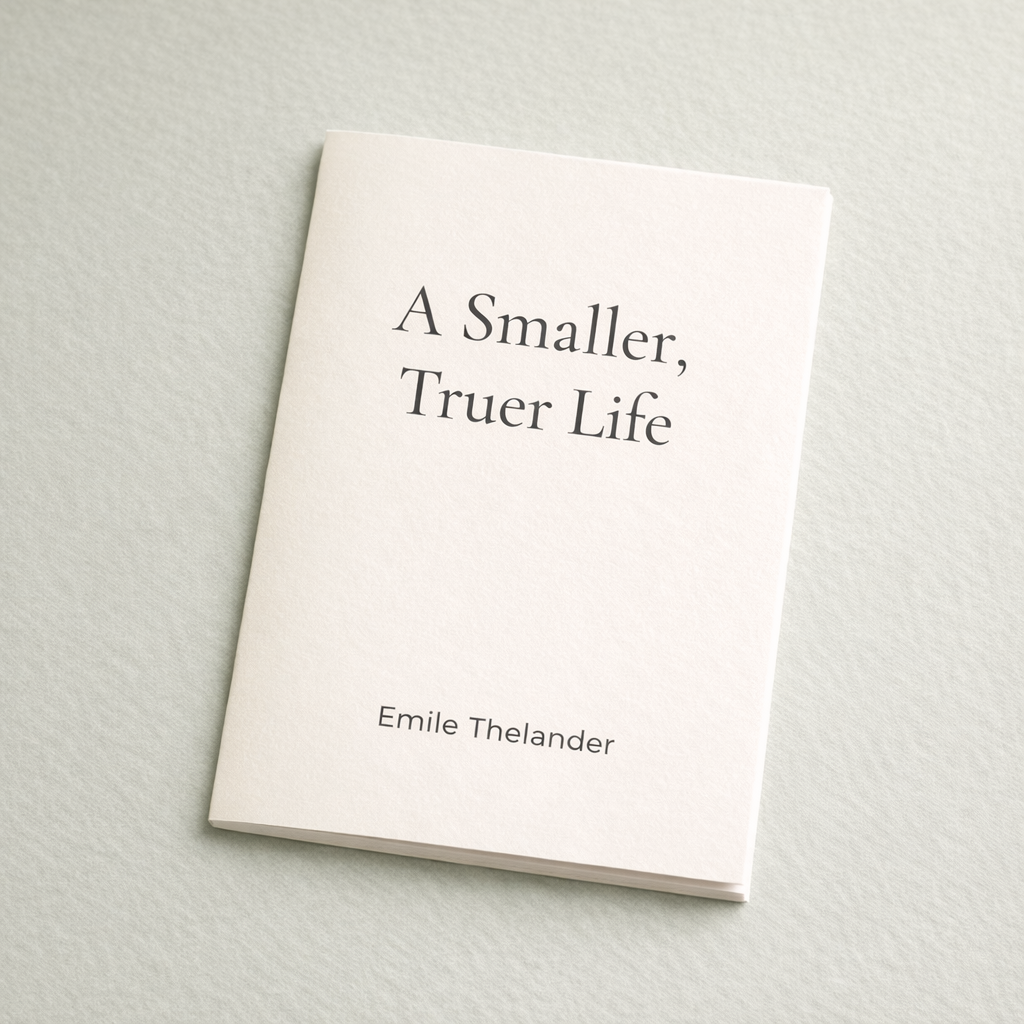
A Smaller, Truer Life
It reflects on pace, performance, momentum, and what becomes visible when you stop forcing yourself to keep up and allow your own rhythm to surface.
There are no instructions here and no productivity lessons – just a short record of what becomes visible when life slows down enough to notice.
If you’re interested in the original fragments, they are collected below:
-
Shared Consequences
I try to build systems so the problem doesn’t appear at all.
Some people just handle things as they come.
Neither is better. But living together means you share the consequences. -
Time Horizons
Some people think in systems.
Some think in emergencies.One builds for next year.
One manages today.The conflict isn’t values.
It’s time.At some point something bends.
The question is which one. -
Not Mine to Carry
I’m noticing a shift.
For a long time, I’ve been the one who holds things together when other people don’t. The backup plan, the emotional stabiliser, the one who makes sense when things get chaotic.
But I don’t want to keep doing that. Not because I’m angry or withdrawing. Just because it’s not mine to carry.
Other people’s indecision is theirs. Their moods are theirs. Their consequences are theirs.
I stay here.
I remain myself.
I don’t pick up what isn’t mine. -
Before the Storm
I get why people thank God when the storm shifts away. Fear needs meaning. But I can’t stomach the idea that prayer just relocates suffering.
Before every typhoon: prayers to an all-knowing, all-powerful God, just in case He decides to deviate from His plan.
-
The Weight and the Balance
There’s a limit to how much you can hold before things start to slip. I’m still trying to find that limit, trying to tell the difference between commitment and slow collapse.
Not everything that depends on you deserves to. Care isn’t proof of strength when it empties you; it’s just another way of losing shape.
I don’t want to give up – I just don’t want to disappear inside the keeping. Some things need to stand on their own, or not at all. Maybe the next version of care is lighter – not about carrying everything, but about walking beside what can move with me.
-
When Passion Becomes Work
I’ve been thinking further about resonance and the myth of doing what you love. Even if I found my tribe – people who actually get me – and even if I could be useful to them with my skills and interests, it wouldn’t magically remove the realities of work.
Work is work. Even in a setting you enjoy, even with people you resonate with, you’re still doing something for money – not necessarily because you genuinely want to do that particular thing in that exact moment.
Take painting as an example. You love painting. You attract other painters. Someone commissions a piece. Suddenly, you’re painting not because inspiration struck, but because someone is paying you. You might produce beautiful work, but it’s no longer purely joy-driven – it’s a job. Deadlines, expectations, and obligations enter, and joy subtly shifts into responsibility.
The same applies to any skill or passion. Even if the people you connect with are like-minded, even if the work aligns with your strengths, once there’s external expectation – whether payment, attention, or reliance – the intrinsic freedom of creation changes.
This is why separating the lanes – income versus resonance – remains crucial. Even when you find your people, even when your work resonates, there will always be a friction point. Awareness of this tension doesn’t make connection or monetisation impossible; it simply allows you to approach both realistically, without romanticising the experience.
Resonance is rare. Connection is fleeting. Joy in creation is fragile once obligation enters. And knowing this lets you operate with clarity – to create freely where you can, and to work where necessary, without expecting the two to perfectly align.
-
On Resonance, Money, and the Myth of Doing What You Love
I’ve been thinking about resonance – real connection with people who actually get me. The ones who notice the texture behind the words, who can sit with a pause, who respond in subtle ways that make conversation feel alive. It’s almost impossible to manufacture.
Threads. I tried it. I wrote, polished, stayed faithful to my truth. Some ideas were mine, some clarified with ChatGPT. Flicker of resonance? Nothing. Zero. Fine. For me, it’s an archive. Honest, first and foremost.
TikTok… I haven’t restarted. I went there a few times, saw the noise, and thought: why bother? But it does offer presence, voice, rhythm – things writing alone can’t convey. Someone might click. But resonance is rare. The algorithm is a fickle god.
I’ve been buying into this cultural lie that doing what you love will produce meaning, connection, and money. Threads, social media, the romanticised creator life – all variations of the same story: create and people will see, resonate, reward. Comforting, seductive, incomplete. It ignores the rarity of resonance and the realities of survival.
Here’s what I’ve realised. Separate the lanes.
Income lane: Practical, survival-focused. Sustain myself, pay the bills, move away from ESL. No resonance required.
Resonance lane: For me. Reflection, presence, honest expression. Low-pressure, low-stakes, may never reach anyone – and that’s fine.
I can pursue each lane on its own terms. No guilt, no forcing a merge. Monetise separately, create freely, and if a few people resonate along the way, bonus. If not, still valuable.
The “do what you love, and money will follow” story? Bullshit. Not literal. A story to feel principled while fumbling around. I can let it go.
Resonance is rare. Connection is sparse. Presence is fleeting. That’s reality. But I can still create, observe, live my rhythm. That’s freeing. That’s the whole point. Stop chasing myths, stop seeking validation, let the rare sparks happen where they may. The rest is just living.
-
Threads, Metrics and Presence
I signed up for Threads for the first time on 27 May. About two weeks later, on 11 June, I decided to do a big social media purge. I deleted all my accounts except Facebook, wanting space to re-evaluate my relationship with social media and where to focus my attention.
During that first two-week period, I posted only a few times. Most of my time was spent consuming content rather than creating it. After a few months off, I signed up again on 16 October. This time, I’ve been active daily, often multiple times a day. I interact with other content but don’t follow anyone – there’s no one I’m keen to follow. If something resonates, I like it. If I feel like commenting, I do so without overthinking. My interactions are like casual small talk in real life.
Two weeks later, despite regular posting and interaction, I haven’t received a single like or comment on any of my posts. Maybe Threads isn’t the place for me. Perhaps if I hadn’t overthought things the first time and had posted more instead of just consuming content, I would have realised this sooner.
I see some of the same things that annoyed me before – catchphrases, stolen jokes, recycled material – but I’m less bothered now. What surprises me is the lack of interaction with my content. I’m not in a rush to delete Threads again; maybe I’ll keep it a while. Still, I don’t see much point in spending a lot of time there if I’m not connecting with people, which is the whole point of social media for me.
For now, I’ve shifted my focus. I’m decoupling from all metrics. Likes, comments, and engagement no longer guide whether I stay or leave. Threads and TikTok remain on my radar, not for validation, but for discoverability and the video layer the latter offers to my personal archiving. Resonance isn’t guaranteed – on TikTok, probably even less – but that’s not the point. The point is to keep what I share discoverable, while preserving my own attention and energy.
-
Why I Have Fourteen Dogs
Having fourteen dogs and few human friends isn’t a sign of isolation; it’s an expression of discernment. I’ve chosen presence over performance. I’m drawn to relationships that don’t demand constant explanation, effort, or emotional bookkeeping. With dogs, there’s no subtext – just a steady exchange of attention and trust. I value that kind of simplicity because it doesn’t drain me or require performance.
This choice also reveals how I see connection: not as something measured by frequency or visibility, but by authenticity. I prefer quiet loyalty to social maintenance. In people, I often sense the subtle negotiations of ego and image – what I call “conditional” relationships. In dogs, I find constancy: they stay when moods shift, when words fail, when everything else fragments.
There’s rebellion in that, too. Choosing a pack over a network is a kind of protest against how most human relationships now function – transactional, curated, shallow. I’ve built an ecosystem that mirrors what I wish human connection could be: instinctive, reciprocal, grounded. I’ve rejected the algorithmic idea of belonging and replaced it with a living, breathing version of community.
Creatively, this reflects how I work. I don’t create to chase attention or approval; I create to stay tethered to what’s real. I want to feel meaning move through me, not through an audience. The dogs are part of that ecosystem – uncritical witnesses who remind me that presence itself is enough.
I haven’t withdrawn from love or life. I’ve just refined where I spend it. I’m not lonely in the usual sense. I’m protecting the integrity of my attention.
-
Why Dogs Are Better
Dogs don’t love you because you’re special. They love you because you’re theirs. You feed them, keep them safe, smell familiar. It’s not romantic, but it’s real.
People will say that makes their love smaller – that it’s just dependence, not choice. Maybe. But most human love isn’t exactly free-range either. We choose the ones who make us feel less alone, who mirror the version of ourselves we can stand. We call it connection; it’s mostly chemistry and timing.
Dogs don’t bother with that kind of story. They want what they want, and when they give affection, it’s clean. No self-justification, no emotional accounting. They’re not loyal because it’s virtuous. They’re loyal because they can’t imagine the alternative.
Maybe that’s not higher consciousness – maybe it’s just instinct. But morality is mostly instinct, rewritten to flatter us.
So no, dogs aren’t better because they’re pure. They’re better because they don’t fake complexity. They don’t lie about what love really is – a need, honestly expressed.